

 Powered by Bioz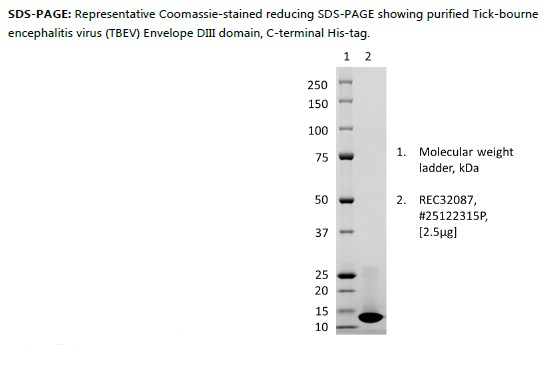
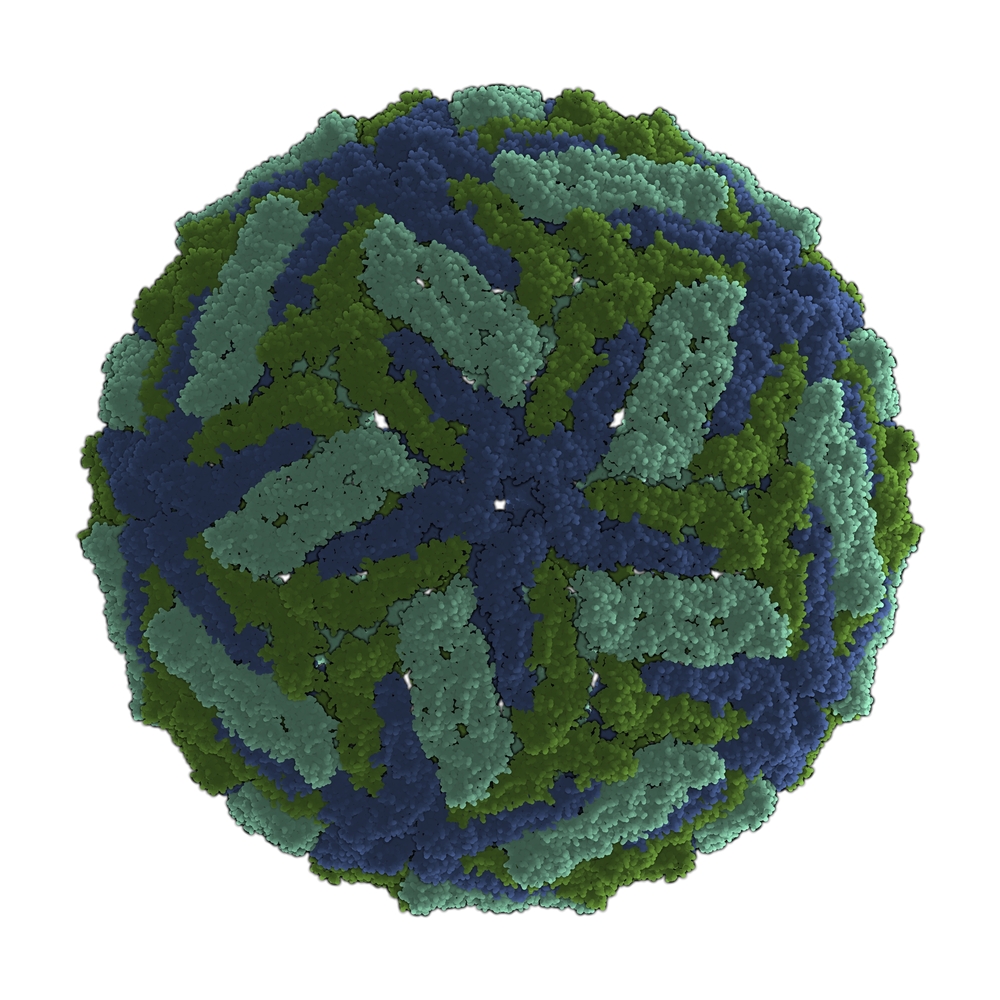
Tick-borne encephalitis virus (TBEV) Envelope DIII domain
Price range: £200.00 through £850.00 excl. VAT
Recombinant Tick-borne encephalitis virus (TBEV) DIII domain of the Envelope protein. The protein was produced in E. coli and purified from cell pellet by immobilized metal affinity and ion exchange chromatography.
Tick-borne encephalitis virus (TBEV) Envelope DIII domain
Recombinant Tick-borne encephalitis virus (TBEV) DIII domain of the Envelope protein. The protein was produced in E. coli and purified from cell pellet by immobilized metal affinity and ion exchange chromatography.
Tick-borne encephalitis virus (TBEV) Envelope DIII domain, Recombinant
- Accession: 6J5F_A
- Strain/Isolate: Neudoerfl
- Tag: His-Tag, C-Terminus
- Expressed in E.coli
- Presented as liquid in 20 mM potassium carbonate, pH 9.6
BACKGROUND
Tick-borne encephalitis virus (TBEV) is a flavivirus that causes tick-borne encephalitis in humans and is transmitted by Ixodes ticks in endemic regions of Europe and Asia, where it is an important cause of viral central nervous system infections (UKHSA; comprehensive TBEV epidemiology review). The envelope (E) glycoprotein of flaviviruses is composed of three domains (I, II and III) and contains a conserved fusion loop in domain II that is involved in membrane fusion and is highly conserved among flaviviruses (Modis et al., 2017). In TBEV, recombinant domains III of the envelope protein E have been produced and used as antigens; when formulated on dextran with CpG, such recombinant domains III induced immune responses, including neutralizing antibodies, and provided partial protection in mice compared with the inactivated vaccine Tick E Vac (Ershova et al., 2016). In multiplex serology, the addition of TBEV envelope protein domain III to NS1 increased sensitivity for TBEV IgG detection while maintaining high specificity (Valle et al., 2024). Furthermore, a stabilized TBEV envelope protein E dimer and its presentation on Mi3 nanoparticles elicited stronger humoral responses than monomeric E and enabled virion like presentation of neutralizing epitopes (Wang & Zhao, 2024).
REFERENCES
- Ershova, A. S., et al. (2016). Recombinant domains III of Tick-Borne Encephalitis Virus envelope protein in combination with dextran and CpGs induce immune response and partial protectiveness against TBE virus infection in mice. BMC Infectious Diseases.
- Modis, Y., et al. (2017). Structures & Functions of Flavivirus Envelope Glycoprotein. Current Opinion in Virology.
- Valle, C., et al. (2024). Multiplex Serology for Sensitive and Specific Flavivirus IgG Detection: Addition of Envelope Protein Domain III to NS1 Increases Sensitivity for Tick-Borne Encephalitis Virus IgG Detection. Journal of Clinical Microbiology.
- Wang, B., & Zhao, H. (2024). Development of a Tick-Borne Encephalitis Virus Nanoparticle Vaccine Utilizing Envelope Dimer. bioRxiv preprint.
- UK Health Security Agency. Tick-borne encephalitis epidemiology diagnosis and prevention.
You may also like…
Tick-Borne Encephalitis Virus (Siberian) NS1 Protein
Price range: £402.78 through £1,461.94 excl. VATTick-Borne Encephalitis Virus (European)NS1 Protein
£402.78 - £1,461.94£281.95 - £1,461.94 excl. VATTick-Borne Encephalitis Virus (Far Eastern) NS1 Protein
Price range: £402.78 through £1,461.94 excl. VAT