

 Powered by Bioz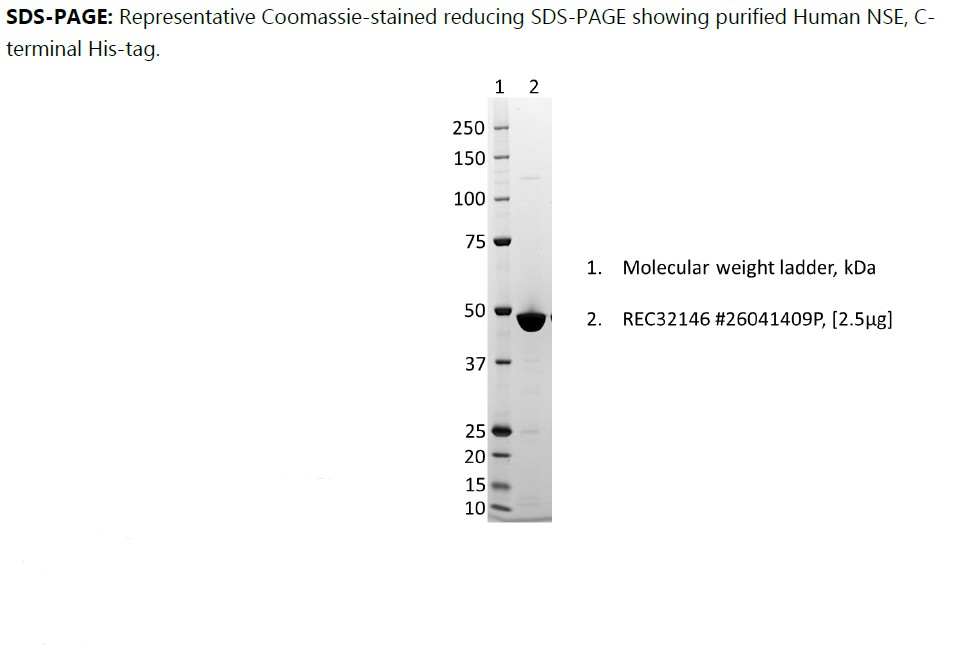
Recombinant Human NSE protein
Price range: £220.00 through £935.00 excl. VAT
Recombinant Human neuron-specific enolase (NSE) with a C-terminal His-tag, expressed in E. coli and purified by metal affinity chromatography.
Recombinant Human NSE protein
Recombinant Human neuron-specific enolase (NSE) with a C-terminal His-tag, produced in Escherichia coli and purified by immobilised metal affinity chromatography.
PRODUCT DETAILS – Human NSE, C-terminal His-tag
- Accession: UniProt P09104
- Expression system: Escherichia coli
- Tag: His-tag (C-terminus)
- Presented as liquid in 50 mM HEPES pH 8.0, 150 mM NaCl, 10 mM MgSO4 pH 7.6
BACKGROUND
Recombinant human neuron‑specific enolase (NSE, ENO2) is a well‑characterised biomarker used as an auxiliary analyte in immunoassays for neuroendocrine malignancies and neuronal injury. NSE is the γ‑enolase isoenzyme encoded by ENO2 and is predominantly expressed in neurons and neuroendocrine cells as γγ or αγ dimers. Elevated circulating NSE concentrations have been reported in small‑cell lung cancer (SCLC), neuroblastoma, and other neuroendocrine tumours, where levels may be associated with tumour burden, disease extent, prognosis, and response to therapy (Isgrò et al., 2020; Birinci et al., 2023). Due to its limited sensitivity and specificity, NSE is not considered suitable as a stand‑alone diagnostic or screening marker and is best interpreted in conjunction with clinical findings, imaging, histopathology, and other laboratory tests (Isgrò et al., 2020).
Recombinant human NSE has been shown to closely resemble native, tissue‑derived NSE in its biochemical structure and immunoreactivity, supporting its use as assay material in immunoassay development. In particular, recombinant NSE has been applied as a reference antigen or calibrator in quantitative immunoassays designed to measure NSE in human serum, enabling controlled assay calibration and analytical evaluation (Hu et al., 2026). As interest in standardised biomarker measurement continues in oncology and neurology research and diagnostics, recombinant NSE represents a practical and reproducible reagent for IVD assay development, optimisation, and quality control, without implying direct clinical performance claims (Ni et al., 2023).
REFERENCES
-
- Isgrò, M. A., Bottoni, P., & Scatena, R. Neuron‑Specific Enolase as a Biomarker: Biochemical and Clinical Aspects. Advances in Experimental Medicine and Biology, 867, 125–143 (2020).
- Birinci, S., Ulgu, M. M., et al. The diagnostic rate and clinical implications of neuron‑specific enolase in neuroendocrine tumours and small‑cell lung cancer. Medical Bulletin of Haseki, 61(4), 231–237 (2023).
- Hu, Y., Si, J., Liang, Z., et al. Accurate neuron‑specific enolase quantification via amino acid analysis‑IDMS enabling immunoassay calibration. Microchimica Acta, 193, 66 (2026).
- Ni, J., Huang, Y., Li, C., et al. Emerging diagnostic and prognostic relevance of ENO2 in cancer. Molecular Therapy – Oncology, 31, 100750 (2023).