

 Powered by Bioz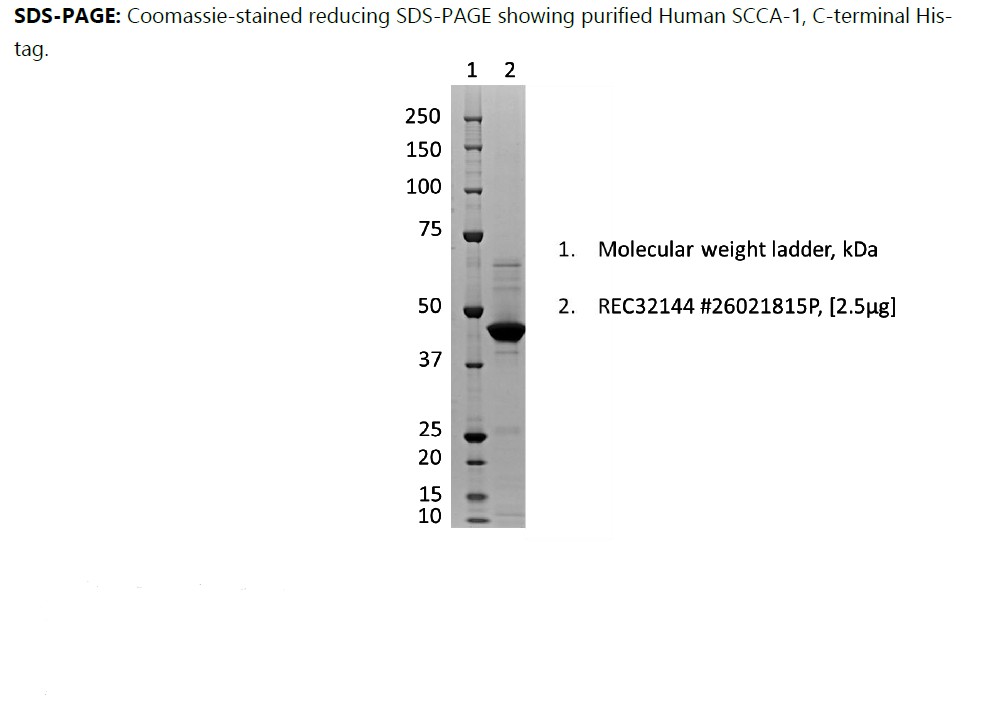
Recombinant Human SCCA-1 protein
Price range: £240.00 through £1,020.00 excl. VAT
Recombinant Human SCCA-1 protein with a C-terminal His-tag, expressed in E. coli and purified by metal affinity chromatography.
Recombinant Human SCCA-1 protein with a C-terminal His-tag, produced in Escherichia coli and purified by immobilised metal affinity chromatography.
PRODUCT DETAILS –Recombinant Human SCCA-1, C-terminal His-tag
- Accession: UniProt P29508
- Expression system: Escherichia coli
- Tag: His-tag (C-terminus)
- Presented as liquid in DPBS
BACKGROUND
Squamous cell carcinoma antigen 1 (SCCA-1), or Serpin B3, is a protease inhibitor involved in apoptosis regulation and immune modulation (Schick et al., 1997; Catanzaro et al., 2014). It is measured clinically as part of the total SCCA serum marker, which aids in the diagnosis and monitoring of squamous cell carcinomas, including those of the lung and cervix (Nakamura et al., 2000; Straube et al., 2022). Recombinant SCCA-1 is essential for these clinical assays, as it provides a defined antigen that allows for the differentiation of SCCA isoforms and the validation of assay specificity (Nakamura et al., 2000).
Recombinant SCCA-1 constructs allow specific study of the SCCA-1 isoform despite issues with cross-reactive antibodies. They are important for standardizing immunoassays and investigating SCCA-1’s role in tumour progression, making them essential for improving diagnosis and monitoring of squamous cell cancers.
REFERENCES
-
- Schick C, et al. SCC-antigen 1 and SCC-antigen 2 are two distinct, but closely related, serpin genes. J Biol Chem. 1997.
- Nakamura M, et al. Immunoreactivity of recombinant squamous cell carcinoma antigen 1 and 2 with monoclonal antibodies. Tumour Biol. 2000.
- Catanzaro JM, et al. SerpinB3 (SCCA1) and its roles in cancer. 2014.
- Straube E, et al. Squamous cell carcinoma antigen: clinical application and its role in disease management.. 2022
